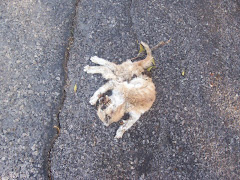
I'm not even sure what to make of this. A website that lists all the great reasons your cat SHOULD be an outdoor cat, but that also lists all the dangers your cat will face while outside?
Ummmm, pardon my French, but
WTF?
There's so much wrong (and only a few things right) with the website, I can only sit here and say, "Hand, meet forehead."
Click here.
Thursday, May 20, 2010

Thursday, April 22, 2010
One person's heartbreak
This story is just one of most likely thousands of similar stories that could be told about outdoor cats.
It doesn't matter what kind of "situation" your cat has at home. They need you to be a smart and caring pet owner and they need to stay inside. Always.
It's unfortunate for the cats that sometimes their owners think they have valid reasons to let the cat roam "free".
It's even more unfortunate when owners make no sense at all and their reasons are illusions they made for themselves.
It doesn't matter what kind of "situation" your cat has at home. They need you to be a smart and caring pet owner and they need to stay inside. Always.
It's unfortunate for the cats that sometimes their owners think they have valid reasons to let the cat roam "free".
It's even more unfortunate when owners make no sense at all and their reasons are illusions they made for themselves.
Monday, September 28, 2009
A letter I am seriously considering putting into distribution in our neighborhood
Dear Neighbor,
This is an open letter to everyone in the neighborhood. Specifically, cat owners.
If you don't own a cat, you are free to recycle this.
And if you have kids who are selling chocolate for fund raising, please send them our way.
Cat Owners:
If you own an indoor cat, then bless you.
If you let your cat roam freely outside, please consider this not a warning, but a declaration.
When you own a pet, there comes a set of responsibilities.
This includes feeding it, loving it, giving it veterinary care and keeping it out of danger. You are promising to keep this animal happy and healthy.
IF YOU LET YOUR CAT ROAM FREE, you are blatantly ignoring your DUTY as a pet owner.
Cats are non-native, predatory animals who kill our native wildlife such as birds, mice, lizards, amphibians, etc. Studies have shown that bird populations and diversity drop dramatically in areas where cats are allowed to roam free. And it's not THEIR FAULT.
If you are about to start explaining to me that "cats are just acting on their instincts", or "My cat won't stay indoors!" or "My cat is happy when he's outside!", please think on this:
Imagine your cat. Better yet, go find your cat and look into his or her eyes.
Now, imagine your cat, just having been hit by a car. Your cat is laying in a ditch, maybe already dead.
Or maybe the blow wasn't quite enough to kill him. Your cat is mangled and in excruciating pain, dragging himself into the weeds. Your cat will spend the next few hours, or maybe a day or two, either bleeding to death or slowly succumbing to starvation, because he is paralyzed and can't get back to the house. Your cat has died a horrible death.
Or maybe a stray dog has gotten hold of your cat. The dog is savagely shaking the life out of your cat. Your cat has died a horrible death.
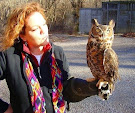
Or maybe your cat has been caught by a great horned owl, or red-tailed hawk. He has been lifted off the ground and taken to a tree where he is being squeezed by hundreds of pounds of pressure so that he will stop struggling so the bird can eat him. Your cat has died a horrible death.
Or maybe your cat has been captured by sick teenagers who set him on fire. Just for fun.
He is left to lay wherever they throw him. Your cat has died a horrible death.
Sick to your stomach yet? You should be.
Ready to wipe these scenarios from your mind? There is one, and only one thing you need to do.
KEEP YOUR CAT IN YOUR HOUSE.
That's it.
And here comes the declaration:
If I find your cat roaming the neighborhood, I will be taking him off the streets to our local shelter where he will have the safety you neglected to provide.
If you didn't have him micro-chipped, then you will probably never see him again.
I will be giving him the chance you never did. Because I care more about him than you do.
If you want to come down and yell at me, feel free.
I'm the Freak Down the Street with all the birds in her yard, and her cats in the HOUSE.
This is an open letter to everyone in the neighborhood. Specifically, cat owners.
If you don't own a cat, you are free to recycle this.
And if you have kids who are selling chocolate for fund raising, please send them our way.
Cat Owners:
If you own an indoor cat, then bless you.
If you let your cat roam freely outside, please consider this not a warning, but a declaration.
When you own a pet, there comes a set of responsibilities.
This includes feeding it, loving it, giving it veterinary care and keeping it out of danger. You are promising to keep this animal happy and healthy.
IF YOU LET YOUR CAT ROAM FREE, you are blatantly ignoring your DUTY as a pet owner.
Cats are non-native, predatory animals who kill our native wildlife such as birds, mice, lizards, amphibians, etc. Studies have shown that bird populations and diversity drop dramatically in areas where cats are allowed to roam free. And it's not THEIR FAULT.
If you are about to start explaining to me that "cats are just acting on their instincts", or "My cat won't stay indoors!" or "My cat is happy when he's outside!", please think on this:
Imagine your cat. Better yet, go find your cat and look into his or her eyes.
Now, imagine your cat, just having been hit by a car. Your cat is laying in a ditch, maybe already dead.
Or maybe the blow wasn't quite enough to kill him. Your cat is mangled and in excruciating pain, dragging himself into the weeds. Your cat will spend the next few hours, or maybe a day or two, either bleeding to death or slowly succumbing to starvation, because he is paralyzed and can't get back to the house. Your cat has died a horrible death.
Or maybe a stray dog has gotten hold of your cat. The dog is savagely shaking the life out of your cat. Your cat has died a horrible death.
Or maybe your cat has been caught by a great horned owl, or red-tailed hawk. He has been lifted off the ground and taken to a tree where he is being squeezed by hundreds of pounds of pressure so that he will stop struggling so the bird can eat him. Your cat has died a horrible death.
Or maybe your cat has been captured by sick teenagers who set him on fire. Just for fun.
He is left to lay wherever they throw him. Your cat has died a horrible death.
Sick to your stomach yet? You should be.
Ready to wipe these scenarios from your mind? There is one, and only one thing you need to do.
KEEP YOUR CAT IN YOUR HOUSE.
That's it.
And here comes the declaration:
If I find your cat roaming the neighborhood, I will be taking him off the streets to our local shelter where he will have the safety you neglected to provide.
If you didn't have him micro-chipped, then you will probably never see him again.
I will be giving him the chance you never did. Because I care more about him than you do.
If you want to come down and yell at me, feel free.
I'm the Freak Down the Street with all the birds in her yard, and her cats in the HOUSE.
Wednesday, July 29, 2009

Saturday, July 12, 2008
A New York Times article about the event that, while it didn't "start" the war, definitely cranked it up to eleven.
Friday, June 27, 2008
A Birder/Cat Owner/Veterinarian's View
One veterinarian’s view:
When starting this conversation, one of the first terms to define is what kind of cat you are talking about. A feral cat is one that is truly “wild,” unowned and living without any, or with very limited, human intervention. Then, there are stray cats, also unowned, but supported in part by people. These include the public cat colonies fed by well-meaning cat lovers and the stray that shows up in your yard from time to time, looking for a handout. Finally, there are owned cats, some of which might be called “barn cats,” owned, fed and casually cared for, but never coming indoors, and pet cats who live mostly indoors, but are allowed some outdoor time as part of their daily routine. Management styles must be modified based on what kind of cat problem you are addressing.
Feral cats actually make up the smallest portion of the cat population. Due to the rigors of their lifestyle, their lifespan is short, approximately 2 years. Poor nutrition means their reproductive rate is low. Without supplemental feeding, litter numbers are small and few kittens survive to adulthood.
Subsidized cat colonies may consist of dozens or even hundreds of cats. Well-meaning but uninformed people who provide food for these cats contribute to the problem by improving the cats’ nutrition, thus increasing their fecundity. The concentration of large numbers of cats in a small area increases the fecal pollution, and raises the risk of zoonotic disease. Cats using park lands or sandboxes put people, especially children, at risk for roundworms (which can cause blindness or neurologic disease) and toxoplasmosis, a cause of human birth defects. Colonies are often in sheltered areas, and the security and reliable food source attracts new feline members. Irresponsible pet owners may dump their unwanted kittens in the vicinity, assuming “someone will care for them.”
Owned cats are the unseen fly in the ointment. Pet owners may believe that their well-fed cat has no need to hunt, but the predatory instinct of a feline will not be denied. Even if not hungry, cats will take and kill birds, small mammals, snakes and frogs.
Leash laws can be enacted for owned cats, but won’t control the feral or stray cat, and would be extremely difficult to police in rural areas, where a good mouser is prized. Colony caretakers won’t tolerate any policy that involves killing their beloved charges. Trapping and removing all cats and kittens allows new strays move into the void, perpetuating the colony. TNR, Trap/Neuter/Release, has been advocated by cat lovers, as it establishes stable and non-reproducing colonies, but doesn’t answer the question of wildlife decimation.
So, what is the answer? The truth is, no one answer fits all the situations. Feral cats are not good candidates for adoption. Trap/Remove might work for feral cats which are in areas where people don’t have proprietary emotional ties to them. TNR of public cat colonies, with adoption of kittens and tame adults, and returning sterilized adults to the colony, is currently the accepted option where public outcry makes removal politically unacceptable. Educating the public is critical for controlling the pet cat population, with a big emphasis on spay and neuter to decrease the ever-burgeoning overpopulation problem.
Friday, June 20, 2008
A few ideas from the birder's side
Wikipedia's definition of "feral cat".
An interesting forum was begun on the Bird Education Network's email list. Laura Erickson and others said this to say:
~~~~~~~~~~~~~~~~~~~~~~
~~~~~~~~~~~~~~~~~~
And none of this takes into account the toxoplasmosis that cats toying with birds usually carry, and how dangerous cat feces, and runoff from them, are to some marine mammals.
~~~~~~~~~~~~~~~~~
But the way to appeal to cat lovers isn't to try to turn them against cats, which is impossible. It's to appeal to their feelings towards birds. People as a rule are shockingly ignorant about wild birds--bringing especially vulnerable species like Piping and Snowy Plovers to the forefront in our discussions of cats, and showing adorable photos of the babies, stressing that they're flightless for a full month after hatching, provides a more engaging platform for discussion.
~~~~~~~~~~~~~~~~~~~~~~~~~~~~~~~~~~~~
Duluth, Minnesota, adopted a cat leash law several years ago. What finally convinced both the City Council and enough citizens was the evidence provided not by ornithologists but by veterinarians and the county health department.
****************************
An interesting forum was begun on the Bird Education Network's email list. Laura Erickson and others said this to say:
~~~~~~~~~~~~~~~~~~~~~~
I would hope we would never demonize any animal, however at the same time we can not sugar coat the facts. Too many irresponsible persons are out there with the idea that "as long as I feed them well these cute little kitties won't hurt anybody." The science simply does not bare that out.
~~~~~~~~~~~~~~~~~~~~~~~~
People often seem to romanticize the "adventures" their kitty gets into, and the "natural" predator role their kitty plays when killing birds and mice, even as they decry Great Horned Owls, foxes, coyotes, and other natural predators for including their kitty in the food chain. People who really want to help outdoor cats should be searching for homes for them. I keep hearing people say that some truly feral cats don't adapt to the indoors. But, ecologically, they don't adapt to the outdoors, either. Because these societies keep bringing new feral cats to the colonies and subsidizing them with food, the cats don't die out as natural predators do when their numbers are higher than local small mammal and bird populations can support. They're quite literally subsidized killers.~~~~~~~~~~~~~~~~~~~~~~~~
~~~~~~~~~~~~~~~~~~
And none of this takes into account the toxoplasmosis that cats toying with birds usually carry, and how dangerous cat feces, and runoff from them, are to some marine mammals.
~~~~~~~~~~~~~~~~~
But the way to appeal to cat lovers isn't to try to turn them against cats, which is impossible. It's to appeal to their feelings towards birds. People as a rule are shockingly ignorant about wild birds--bringing especially vulnerable species like Piping and Snowy Plovers to the forefront in our discussions of cats, and showing adorable photos of the babies, stressing that they're flightless for a full month after hatching, provides a more engaging platform for discussion.
~~~~~~~~~~~~~~~~~~~~~~~~~~~~~~~~~~~~
Duluth, Minnesota, adopted a cat leash law several years ago. What finally convinced both the City Council and enough citizens was the evidence provided not by ornithologists but by veterinarians and the county health department.
Subscribe to:
Posts (Atom)